How to Use a Bow Square: Quick Guide
Setting up your bow for peak performance starts with precision, and nothing delivers that like a bow square. Whether you’re tuning a compound or recurve, knowing how to use a bow square correctly ensures consistent arrow flight, accurate sight alignment, and reliable shot-to-shot results. This tool eliminates guesswork by giving you objective measurements for nocking point height, brace height, tiller, peep sight alignment, and more.
In this guide, you’ll learn exactly how to use a bow square for every critical setup task. You’ll discover which measurements matter most, how to avoid common mistakes, and pro tips from experienced archers to get the most out of your equipment.
Set the Nocking Point Accurately
The nocking point is where your arrow attaches to the string. Getting its vertical position right ensures level arrow launch and consistent grouping.
Establish the Zero Reference Point
Place your bow vertically on a stable surface, unstrung or at rest. Clip the horizontal arm of the bow square onto the bowstring, then slide it down until the arm rests flush against the arrow rest or shelf on recurves. This horizontal plane is your zero reference, where the arrow shaft naturally sits.
On many compound bows, especially single-cam models, the string is not perfectly vertical when at rest. Always reference the arrow rest, not the riser, for accurate alignment.
Position the Nock Above Center
Most setups require the arrow nock to sit slightly above center to compensate for arrow flex upon release.
Standard height ranges to aim for:
• 1/8″ to 3/16″ above the zero point for most setups
• 1/4″ above center for drop-away rest users to account for rest movement during shot execution
Slide the bow square up the string to the desired height, ensuring it remains level.
Mark and Install the Nocking Point
Use a fine-tip marker to mark the string at the bottom of where the arrow nock will sit. For temporary reference before final installation, tie a small loop of dental floss around the string at this point to preserve the position even if the string shifts.
When ready to install permanently:
• Install a brass nock just above the arrow nock for single nocking point
• Or use double nocks to sandwich the arrow nock and prevent slippage
• Secure with tightly wrapped serving thread, double-overhand knotted
• Apply string glue or super glue only after final positioning is confirmed
Frequent re-tying of nocking points can damage the center serving over time. Always mark first with a marker or floss loop before making permanent changes.
Measure Arrow Rest Height

Arrow height affects clearance, arrow flight, and tuning stability. Use the bow square to verify it is set correctly.
Check Vertical Clearance
With an arrow nocked, place the bow square on the string and align the horizontal arm with the arrow rest. Measure from the bottom of the shelf to the top of the arrow shaft.
Typical range for most setups:
• 5/8″ to 3/4″ depending on rest type and bow design
• For drop-away rests, ensure the arrow sits level or slightly high before release
Alternatively, measure along the side of the riser to compare arrow height across different setups. If your arrow appears cocked too high or low, use this measurement to diagnose misaligned rests or incorrect nock height.
Measure Brace Height Correctly
Brace height, the distance from the deepest part of the grip to the string, impacts speed, forgiveness, and noise.
Align Square to Grip Throat
Place the horizontal arm of the bow square into the deepest part of the grip, also known as the throat or pivot point. Make sure it sits flush and stable with no tilting. Extend the vertical ruler toward the string and read where the string crosses the scale. This is your brace height.
The indent between the clips should be pushed firmly into the throat of the grip for accurate measurement.
Adjust Within Manufacturer Range
Most bows specify an optimal brace height range, typically 7.5″ plus or minus 0.25″. To adjust:
To shorten brace height for faster arrow but less forgiveness:
• Add twists to the string using a string twister
To lengthen brace height for more forgiveness and quieter operation:
• Remove twists or install a longer string
Always re-measure after adjustments and test arrow groups. Short brace heights in the 6″ to 7″ range produce faster arrows but are harder to tune, while longer brace heights from 8″ to 9″ offer more stability and are better for beginners.
Check and Tune Tiller (Recurve Bows)

Tiller ensures balanced energy transfer between limbs. It is measured as the difference between top and bottom limb-to-string distances.
Measure Top and Bottom Limb Distances
Place the horizontal arm against the bottom of the grip or riser. Read where the string crosses the ruler to get the bottom tiller measurement. Flip the bow or reposition the square at the top of the grip and read the measurement for top tiller.
Subtract the bottom value from the top. For example, if top reads 8.25″ and bottom reads 8.00″, you have +0.25″ positive tiller.
Competitive recurve shooters often prefer +1/8″ to +1/4″ positive tiller to reduce hand shock and improve arrow clearance.
Adjust with Limb Bolts
Turn limb bolts in 1/8-turn increments to make adjustments:
• Loosen the top bolt to increase top tiller
• Tighten the bottom bolt to decrease bottom tiller
Retest draw feel and groupings after each change. Tiller adjustment is rarely needed on compound bows since cam design handles limb balance.
Align the Peep Sight Precisely
A misaligned peep ruins consistency. Use the bow square to ensure it lines up with your anchor point.
Measure from D-Loop to Peep Center
Place the bow square on the top of the D-loop. Let the ruler hang vertically down the string. Measure the distance to the center of the peep sight. Adjust the peep so it aligns with your natural line of sight at full draw and anchor.
Record this measurement so you can reposition the peep accurately if it rotates. A rotated peep causes inconsistent aiming, so verify alignment before every shooting session.
Measure Pin Gaps for Multi-Pin Sights
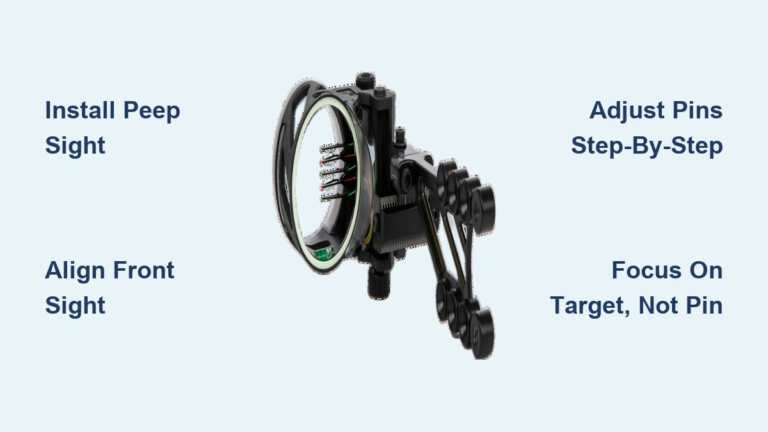
Consistent spacing between sight pins improves accuracy and allows quick re-setup.
Use Square for Exact Spacing
Place the bow square behind the sight housing. Align the horizontal arm with the first pin and read the vertical distance to the next pin. Repeat and record all pin gaps.
Typical pin gap ranges:
• 3/8″ to 1/2″ depending on bow speed and draw length
Recording pin gaps lets you replace or reinstall sights without re-sighting in from scratch.
Locate the D-Point for Cam Timing
The D-point is where the string separates from the cam on a compound bow. Measuring it helps diagnose timing issues or cam lean.
Flip Square to Measure Separation
Rest the bow square on the arrow rest. Flip it upside down and place the horizontal arm across the inside top and bottom of the cam/string separation. Record the measurement for tuning reference.
Compare D-point measurements after string stretch or replacement to detect cam timing shifts.
Choose the Right Bow Square Type
Not all bow squares are equal. Match the design to your bow and tuning needs.
Flat L-Shaped Squares
Best for recurve bows or basic tasks. Has a solid horizontal arm but may not simulate real arrow pressure.
Standard flat arms do not mimic how an arrow contacts the string, potentially reducing accuracy in nocking point placement.
Rounded or Notched Edge Squares
Designed for compound bows. The curved or slotted crossbar clips securely onto the string.
Some require approximately 15 lbs of pressure to clip on, so ensure firm attachment to prevent slippage.
Arrow-Shaped or Horseshoe Squares
Mimics the arrow profile, cradling the string like a real arrow. Offers superior simulation of actual arrow interaction.
Attach a 2″ slitted aluminum arrow shaft to the square’s arm to simulate arrow weight and pressure, which improves nocking point realism.
Dual-Scale and Adjustable Models
Dual-scale rulers often have different calibrations:
• Inch side for string-mounted use like nocking point
• cm side for grip-mounted use like brace height
Always test your square’s calibration since different models have different offset starting points. Write directly on your square: “cm equals brace height, inches equals nocking point.”
Apply Best Practices for Reliable Results
Follow these habits to maximize accuracy and safety.
Safety First: Position Opening Away
Always orient the bow square with the opening facing away from your face. If it slips off the string, it will not fly toward your eyes.
Support the Bow Vertically
Rest the bow firmly on the ground or in a bow vise. Never hold it freehand during measurement because this introduces tilt and error.
Clean and Inspect Regularly
Check for bent rulers, worn edges, and loose joints. A damaged square gives false readings.
Record All Measurements
Keep a tuning log with nock height, brace height, tiller values, peep-to-D-loop distance, pin gaps, and D-point readings.
Recommended workflow:
1. Start nocking point at 1/8″ above center
2. For dual cams, begin with nock at 90° to Berger hole
3. For single cams, start at 1/8″ high and adjust via rest
4. Fine-tune with paper tuning or bare shaft testing
5. Adjust rest and nock together for optimal flight
Solve Common Problems
Fix issues fast with targeted troubleshooting.
| Problem | Cause | Solution |
|---|---|---|
| Inconsistent arrow flight | Nock too high or low | Re-measure using rest as reference |
| Nocking point slips | Damaged serving from re-tying | Mark first with marker or floss loop |
| Peep sight misaligned | Rotation or improper spacing | Measure from D-loop using square |
| Poor arrow clearance | Incorrect tiller | Adjust limb bolts in small increments |
| Flat square feels inaccurate | Does not simulate arrow pressure | Add slitted arrow piece to arm |
| String not plumb to riser | Cam design quirk | Set nock relative to rest, not riser |
Use the plunger hole as a fine-tuning reference to help match nock height to dynamic spine behavior.
Recommended Tools and Accessories
Equip your tuning kit for success.
• Bow square (T-shaped or L-shaped) for primary measurements
• Fine-tip marker for marking string
• Painter’s tape to label riser with key measurements
• Dental floss as temporary nock position marker
• Serving thread and glue for permanent nock installation
• Slitted aluminum arrow piece to simulate real arrow contact
• String twister for efficient brace height adjustment
• Measuring tape to verify dimensions
• Tuning log or notebook to track all changes
Frequently Asked Questions About Using a Bow Square
What is a bow square used for in archery?
A bow square measures critical bow dimensions including nocking point height, brace height, tiller, peep sight alignment, pin gaps, and D-point location. It transforms subjective setup into objective, repeatable measurements for consistent arrow flight.
How do I measure brace height with a bow square?
Place the horizontal arm of the bow square into the deepest part of the grip (throat). Extend the vertical ruler toward the string and read where the string crosses the scale. This measurement affects arrow speed, forgiveness, and noise level.
What height should I set my nocking point?
Start with the arrow nock positioned 1/8″ to 3/16″ above the arrow rest. For drop-away rests, consider 1/4″ above center to account for rest movement during shot execution. Fine-tune through paper tuning or bare shaft testing.
Can I use a bow square on both compound and recurve bows?
Yes, bow squares work with both bow types. However, recurve archers use them more frequently for tiller adjustment, while compound archers focus on D-loop positioning, peep alignment, and brace height checks.
Why does my bow square have two different scales?
Dual-scale models calibrate one side for string-mounted measurements (inches for nocking point) and the other for grip-mounted measurements (centimeters for brace height). Test your specific model to confirm which scale matches which function.
How often should I check my bow measurements?
Check measurements before competitions, after string replacements, when switching arrows, or when experiencing inconsistent groups. Recording all measurements in a tuning log helps you replicate successful setups and diagnose problems quickly.
Key Takeaways for Mastering Your Bow Square
The bow square is a low-cost, high-impact tool that turns archery setup from guesswork into repeatable science. By enabling accurate measurement of nocking point, brace height, tiller, peep alignment, pin gaps, and D-point, it helps you diagnose issues, replicate winning setups, and optimize performance across seasons and equipment changes.
Start with the basics: set your nocking point 1/8″ above center using the arrow rest as your zero reference, measure brace height from the grip throat, and record every measurement in a tuning log. For recurves, check tiller balance through limb bolt adjustments. For compounds, verify peep alignment and D-loop positioning.
The key to precision is consistency. Always support your bow vertically, orient the square away from your face for safety, and verify your scale calibration before taking measurements. With practice, the bow square becomes your portable tuning log and an indispensable part of your archery toolkit.