
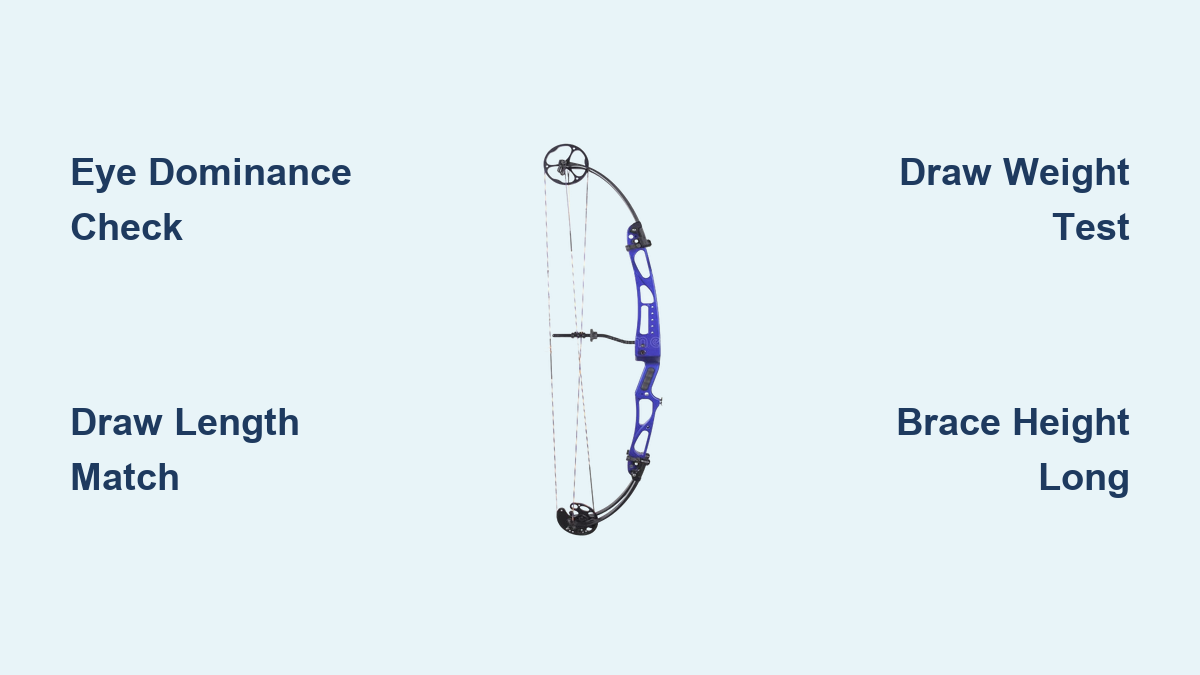
How to Choose a Compound Bow for Hunting
Choosing the right compound bow for hunting can make the difference between a clean, ethical harvest and a missed opportunity. Unlike target bows designed for precision on the range, hunting bows must perform under real-world conditions—cold weather, tight treestands, dense brush, and heart-pounding moments when game appears. The best hunting bow isn’t always the fastest or lightest on paper, it’s the one you can shoot accurately, quietly, and confidently when it matters most.
This guide cuts through technical jargon to deliver actionable insights based on real hunting needs. You’ll learn how to match your body type, draw length, and hunting environment to the ideal bow specs—bracing height, axle-to-axle length, draw weight, and let-off—while avoiding common pitfalls like over-bowing or buying based on hype.
Determine Your Dominant Eye for Correct Bow Handedness
Your dominant eye determines which bow hand you should use, not your dominant hand. Matching the bow to your dominant eye leads to better aim and consistency.
Test for Eye Dominance
Follow these steps to identify your dominant eye:
- Extend both arms and form a small circle with your thumbs and index fingers.
- Focus on a distant object through the opening at arm’s length.
- Close one eye at a time.
* If the object stays centered when your right eye is open, you are right-eye dominant.
* If it shifts when you close your right eye, you are left-eye dominant.
Choose Bow Handedness Correctly
A right-handed bow is held in the left hand and drawn with the right. A left-handed bow works the opposite way. Always match the bow to your dominant eye, not your dominant hand. Shooting with your non-dominant eye leads to poor aim and inconsistency.
Handle Cross-Dominance
If you’re right-handed but left-eye dominant, you have several options. You can shoot with a left-handed bow despite being right-handed. You can use an occluder to block the dominant eye. Or you can train to switch eye dominance over time. For most hunters, switching bow hand is more effective than fighting natural eye alignment.
Calculate Your Ideal Draw Length for Accurate Shooting
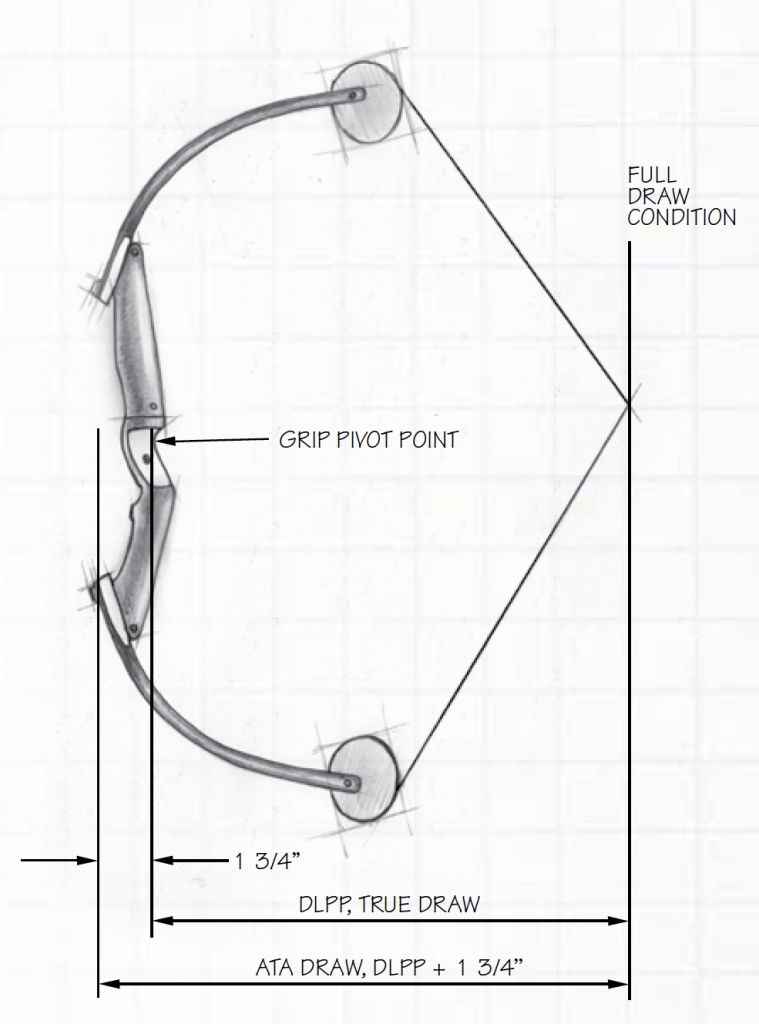
Draw length directly affects accuracy, comfort, and safety. Getting this measurement wrong leads to poor form and potential injury.
Measure Using Wingspan
Use the wingspan method to estimate your draw length:
- Stand straight with arms outstretched horizontally.
- Measure fingertip to fingertip in inches.
- Divide by 2.5 to get your estimated draw length.
* Example: 70-inch wingspan divided by 2.5 equals 28 inches.
An alternative formula is wingspan minus 15 inches, divided by 2. These are estimates only. Final draw length should be confirmed with a professional using a draw board.
Why Draw Length Matters
Too long a draw causes overstretching, poor anchor, string slap, torque, and injury risk. Too short a draw reduces power, arrow speed, and energy transfer, leading to early release. If you fall between sizes, choose shorter. A slightly short draw improves form and consistency, especially under hunting stress.
Check Adjustability
Most modern compound bows offer half-inch to one-inch draw adjustment via cam modules. Never exceed manufacturer limits. Ensure your chosen model can be fine-tuned to your exact draw.
Choose the Right Draw Weight for Your Body Type
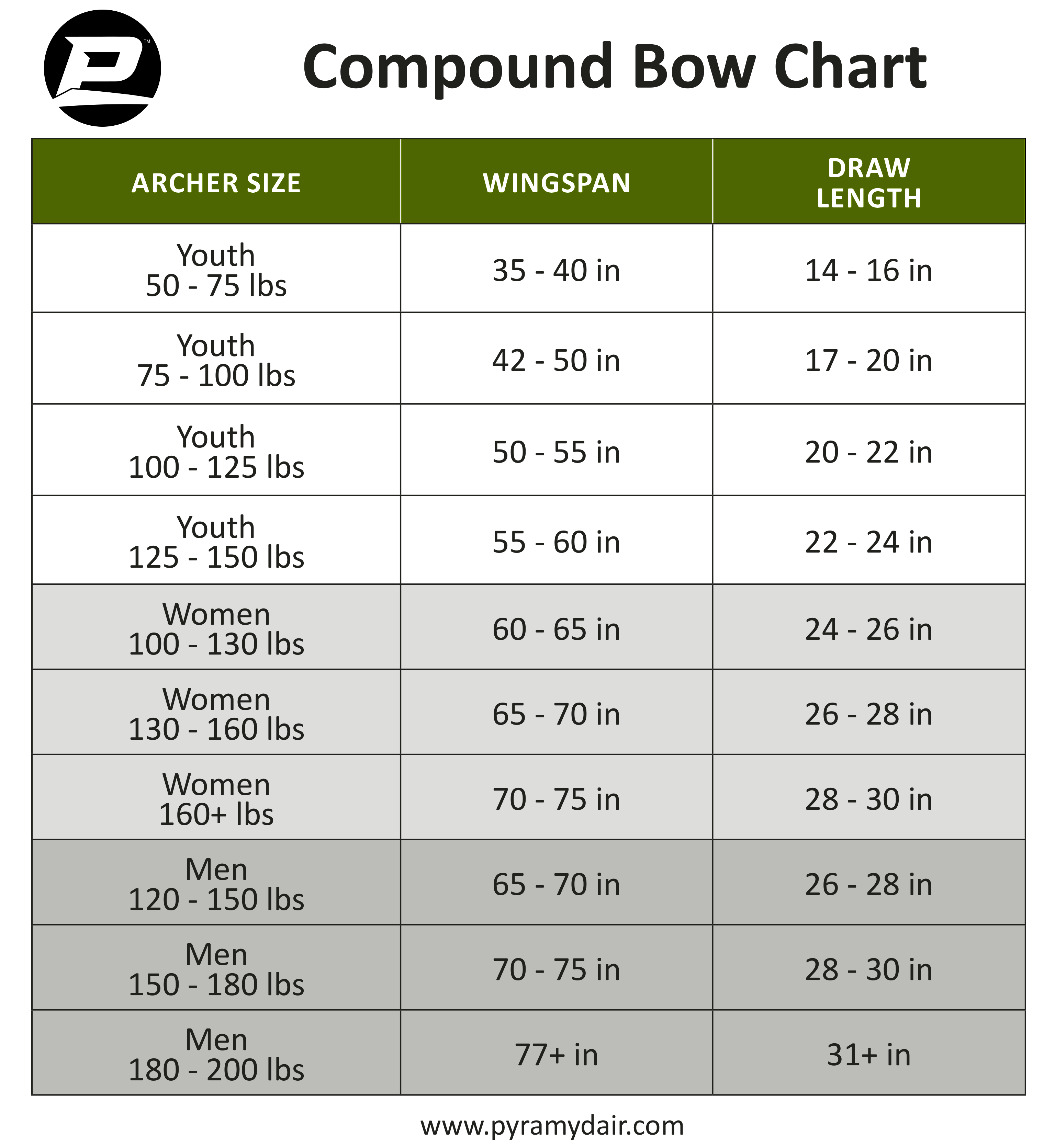
Draw weight impacts arrow speed, kinetic energy, and shooting endurance. Choose based on strength, not ego.
Know Your Body-Based Range
Select a draw weight that matches your physique. Large men (180+ lbs) should target 65 to 75 pounds. Medium men (150 to 180 lbs) typically need 55 to 65 pounds. Small men (120 to 150 lbs) do well with 45 to 55 pounds. Large women (160+ lbs) should aim for 45 to 55 pounds. Medium women (130 to 160 lbs) typically need 30 to 40 pounds. Small women (100 to 130 lbs) often shoot 25 to 35 pounds comfortably.
Test for Functional Holding Power
Draw and hold at full draw for 20 to 30 seconds. If you shake, struggle to aim, or fatigue quickly, the weight is too high. Cold weather stiffens muscles, so what feels manageable in summer may be exhausting in December.
Meet Minimum Legal Requirements
Most states require 40 pounds minimum for deer hunting. Elk, moose, or bear often require 50 to 60 pounds. Best practice is to aim for at least 45 pounds to ensure ethical penetration.
Maximize Kinetic Energy
Higher draw weight means more speed, momentum, and kinetic energy. For deer-sized game, target 40 to 45 foot-pounds of kinetic energy. For elk or bear, 50 or more foot-pounds is recommended. Use online kinetic energy calculators with your arrow weight and speed to verify effectiveness.
Find the Perfect Brace Height for Hunting Accuracy

Brace height is the distance from grip pivot to string at rest. This spec significantly affects forgiveness and accuracy.
Short vs. Long Brace Height
Short brace heights (5.5 to 6.5 inches) deliver faster arrow speed and flatter trajectory but less forgiveness. Long brace heights (7 to 8.5 inches) provide more forgiveness, smoother release, and better accuracy under stress.
Why Long Brace Helps Hunters
Longer brace height reduces the time the arrow spends on the string, minimizing the impact of shooter error. This proves critical in high-pressure moments when form breaks down due to adrenaline or cold. Short brace bows demand perfect form, which works fine on the range but proves risky in the woods.
Choose Based on Skill and Hunting Style
Beginners and treestand hunters should opt for 6.75 inches or longer for forgiveness. Experienced flatland shooters may prefer shorter brace for speed at longer ranges. Mountain hunters value stability over raw speed.
Select the Right Axle-to-Axle Length for Your Environment
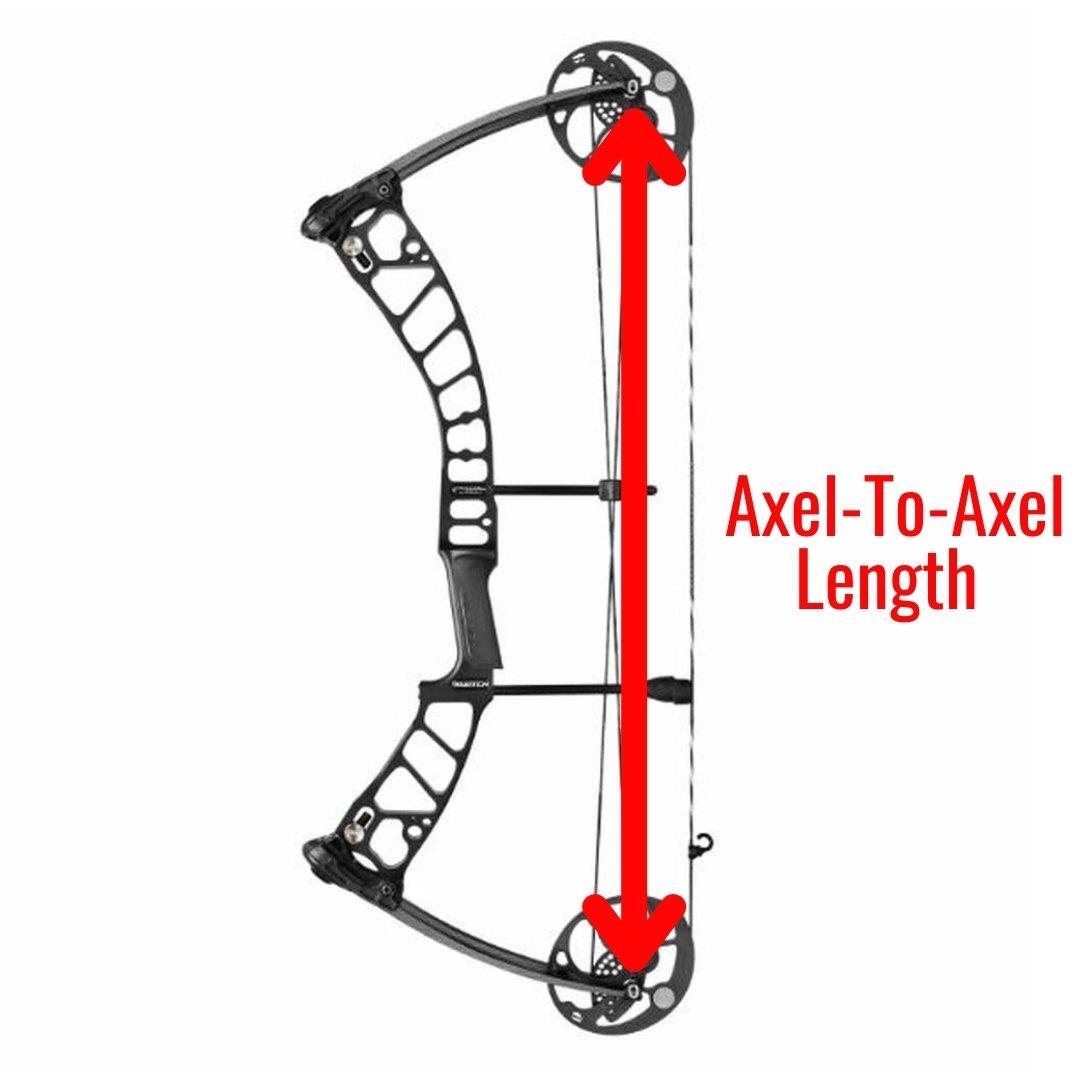
Axle-to-axle length affects balance, stability, and portability. Choose based on where you primarily hunt.
Understand ATA Length Trade-offs
Bows in the 28 to 30-inch range work best for tight blinds, thick cover, and easy carry. Bows in the 31 to 33-inch range offer balanced performance, ideal for most hunters. Bows over 34 inches excel at long-range accuracy but prove less practical in brush.
Pick Based on Hunting Environment
For whitetail in woods, 30 to 33 inches provides enough stability and excellent maneuverability. For open-country mule deer or elk, consider 33 to 34 inches for better long-range control. Backcountry hunters should prioritize compact size for easier hiking and climbing.
Match Bow Weight to Your Hunting Style and Terrain
Bow weight affects portability and shooting stability. Choose based on your typical hunt duration and terrain.
Lightweight vs. Heavy Bows
Bows under 4.0 pounds are easier to carry but produce more vibration and louder shots. Bows between 4.0 and 4.5 pounds offer good balance of portability and stability. Bows over 4.6 pounds deliver smoother shots with reduced hand shock but cause fatigue during long holds.
Match Weight to Your Hunt
For backcountry or mountain hunting, choose under 4.5 pounds bare weight. For stand hunting near a vehicle, slight extra weight improves shot execution. For all-day sits, lighter bows reduce fatigue. Remember that accessories add 1 to 2 pounds. Factor in sight, quiver, stabilizer, and dampeners when judging total weight.
Pick a Cam System That Delivers Smooth Draw Cycles
The cam system controls the draw cycle, energy storage, let-off, and overall feel of your bow.
Compare Cam Types
Single cams offer smooth draw and low maintenance, best for hunters wanting simplicity. Hybrid cams provide balanced speed and smoothness, good for mixed use. Binary cams deliver high sync and easy tuning, preferred by precision shooters. Twin cams provide the fastest speeds and most efficiency but require tuning.
Prioritize Smoothness Over Speed
Aggressive cams offer high let-off (80 to 90 percent) and fast speeds but often have harsh draw cycles. What feels easy in July may be brutal after hours in a cold stand. A comfortable draw cycle beats raw speed every time in real hunting scenarios.
Let-Off: Your Secret Weapon
Let-off reduces holding weight at full draw. A 60-pound draw with 85 percent let-off means only 9 pounds of holding weight. This lets you stay steady while waiting for a deer to step into range. Deep valleys allow muscle relaxation, ideal for long holds. Shallow valleys require constant engagement, preferred by precision shooters.
Understand How Riser Design Affects Bow Performance
The riser is the central frame that influences balance, brace height, and shooting dynamics.
Reflex, Deflex, or Straight
Reflex risers curve forward and increase speed while reducing brace height. Deflex risers curve backward and enhance forgiveness and accuracy. Straight risers offer neutral balance between speed and stability. Most hunting bows use reflex or straight designs to optimize compactness and speed.
Material Matters
Aluminum risers are durable, widely used, and affordable. Carbon fiber risers are lighter and stiffer, ideal for backcountry use but more expensive. For most hunters, aluminum offers the best value.
Why IBO Speed Ratings Don’t Tell the Full Story
IBO speed is measured at 70-pound draw weight, 30-inch draw length, and 350-grain arrow. Real-world setups typically shoot 20 to 50 fps slower due to lighter draw weights, shorter draws, and heavier hunting arrows.
Speed vs. Shootability
Faster bows often sacrifice noise control, vibration dampening, and forgiveness. A 310 fps bow that’s quiet and steady outperforms a 340 fps bow that’s loud and jarring. Consistency beats speed. A well-placed 290 fps shot kills just as dead.
Reduce Noise and Vibration for Stealthy Hunting
A loud shot spooks nearby game and ruins follow-up opportunities. Minimize noise for better hunting success.
What Increases Noise
Short brace height, lightweight construction, aggressive cams, and lack of dampeners all increase noise. Consider these factors when selecting your setup.
Reduce Noise Effectively
Install limb dampeners (rubber or gel pads). Add string silencers (woolies or rubber beads). Use a soft cap on the stabilizer. Choose bows with integrated noise-reduction technology.
Why Ready-to-Shoot Packages Save Money and Time
RTS packages include the bow plus matched accessories and case. They save significant money compared to buying parts separately.
Bare Bow vs. RTS
A bare bow requires separate purchase of sight, rest, arrows, quiver, release, and more. An RTS package includes arrows cut to your draw length, pre-installed sight and rest, and often a quiver and case.
Why Beginners Should Choose RTS
RTS packages save $200 to $400 versus buying parts separately. They ensure compatibility and come pre-tuned or easily adjustable. Look for bundles that include arrows (proper spine and weight), pre-installed sight and rest, peep sight and D-loop, quiver and case, and sometimes a release aid.
Pair Arrows and Fletching With Your Broadheads
Arrows are integral to bow performance. Proper matching ensures reliable flight and deep penetration.
Choose Fletching Material
Plastic vanes are durable, weatherproof, and work with all rests. Feathers are lightweight, promote faster spin, and improve broadhead flight, but require no-contact rests.
Pick Fletching Configuration
Straight fletching provides minimal drag and works with all rests. Offset fletching (1 to 3 degrees) offers good clearance and stability. Helical (spiral) fletching provides maximum rotation, best for broadhead tuning. Use helical fletching if shooting mechanical or fixed-blade broadheads.
Adjust Peep Sight for Optimal Accuracy
The peep sight is your rear aiming reference. Proper setup ensures consistent aiming.
Choose Aperture Size
A one-sixteenth inch aperture provides high precision in bright conditions. One-eighth inch offers balanced performance and remains most popular. Three-sixteenths inch works best in low light, dawn, and dusk. One-quarter inch provides maximum brightness but reduced precision. For hunting, one-eighth to three-sixteenths inch offers the best compromise.
Set Correct Height
Standard peep height is 5.1 inches above the nocking point. High peep options reach 5.9 inches for long draws or low anchors. Peep must align perfectly with your anchor point for consistent aiming.
Test Multiple Bows Before Making a Purchase
No spec sheet replaces personal experience. A bow that feels right in your hands outperforms a better bow that doesn’t fit.
Shoot Like You Hunt
Visit a pro shop and test bows under real conditions. Shoot from a seated position to simulate treestand. Hold at full draw for 20 or more seconds. Use a release aid, not fingers. Evaluate draw smoothness, full-draw comfort, stability while aiming, and ease of consistent anchor.
Trust Feel Over Specs
Avoid decisions based on marketing claims, IBO speed, friend recommendations, or celebrity endorsements. The best bow is the one you shoot the best.
Establish a Realistic Budget for Your Compound Bow
Price tiers help you understand what you’re getting for your money.
Know the Price Tiers
Entry-level bows under $500 work for beginners with basic kits and limited tuning. Mid-range bows from $500 to $1,000 offer the best value with high-quality parts and often include RTS packages. Flagship bows over $1,000 suit enthusiasts seeking marginal gains over mid-tier performance.
Maximize Value
Mid-range bows offer 90 percent of flagship performance at half the price. Avoid entry-level bows with poor tuning or weak limbs. Factor in accessory costs if buying bare bow. RTS packages often save hundreds of dollars.
Why Professional Fitting Matters for Hunting Success
Even experienced archers benefit from professional tuning. A pro shop ensures your bow fits properly.
What Professional Fitting Includes
A professional fitting covers body measurements (wingspan, arm length), draw length calibration, draw weight adjustment, grip and anchor assessment, and shooting evaluation. They confirm draw length and weight, set brace height and cam timing, align peep sight to anchor point, and tune arrow flight.
Buy Locally When Possible
Local pro shops provide ongoing support, repairs, and community access. This relationship proves invaluable as you develop your skills.
Complete This Checklist Before Buying Your Bow
Before purchasing, confirm the following:
- Dominant eye matches bow hand.
- Draw length verified by a professional.
- Draw weight is what you can hold for 30 seconds.
- Brace height is 6.75 inches or longer for forgiveness.
- Axle-to-axle length is 30 to 34 inches based on hunting style.
- Bare weight is under 4.5 pounds for field use.
- Cam system offers smooth, manageable draw.
- Let-off is 80 to 90 percent for easy holding.
- RTS package includes matched arrows and accessories.
- Fletching setup stabilizes broadheads.
- Peep size and height suit your lighting and anchor.
- Bow feels comfortable and consistent after multiple shots.
Frequently Asked Questions About Choosing a Compound Bow for Hunting
What draw weight do I need for deer hunting?
Most states require a minimum of 40 pounds for deer hunting, though 45 to 50 pounds is recommended for ethical kills. Larger game like elk or bear typically requires 50 to 60 pounds.
How do I know my correct draw length?
Measure your wingspan from fingertip to fingertip and divide by 2.5. Have this verified by a professional at an archery shop using a draw board for accuracy.
Should I choose a shorter brace height for faster arrows?
Longer brace heights (6.75 inches or more) are better for hunting because they offer more forgiveness when form breaks down under pressure. The speed difference matters less than accuracy.
What’s the best axle-to-axle length for whitetail hunting?
For typical whitetail hunting in wooded areas, 30 to 33 inches provides the best balance of maneuverability and accuracy. Longer bows help at distances beyond 30 yards.
Are RTS packages worth it for beginners?
Yes. RTS packages save $200 to $400 compared to buying components separately. They ensure compatibility, include arrows matched to your draw length, and come pre-tuned.
How important is IBO speed rating?
IBO speed matters less than you might think. The difference between 300 fps and 330 fps at 30 yards is only 1 to 2 inches of drop. Consistency, quietness, and forgiveness matter more in real hunting situations.
Key Takeaways for Choosing Your Hunting Compound Bow
The best compound bow for hunting isn’t the fastest, lightest, or most expensive. It’s the one that fits your body, matches your strength, and lets you shoot accurately under pressure. Prioritize comfort, consistency, and confidence over specs. Get professionally fitted, test thoroughly, and choose the bow you shoot best. That’s the bow that delivers ethical, successful hunts for years to come.