How to Shoot a Compound Bow: Beginner’s Guide
You’ve picked up your first compound bow, and you’re ready to hit the target. Learning how to shoot a compound bow for beginners isn’t about pulling the string and letting go. It’s about proper setup, consistent form, and deliberate practice. Whether you’re aiming for target accuracy or preparing for your first hunting season, mastering the fundamentals now saves you frustration later.
This guide breaks down everything you need to know step by step. You’ll learn how to set up your bow correctly, build repeatable shooting form, choose the right release technique, and practice like a pro. No fluff, no jargon. Just clear, actionable steps that work.
Set Up Your Bow for Your Body

Before you nock an arrow, your bow must match your body and skill level. A poorly adjusted bow leads to bad habits, sore muscles, and missed shots.
Match Draw Length to Your Wingspan
Your draw length determines how far you pull the string, and it must fit your arm span. Too short, and you’ll torque the bow. Too long, and you’ll strain your shoulder trying to anchor.
To estimate your draw length:
- Measure your wingspan from fingertip to fingertip
- Divide by 2.5 to get approximate draw length in inches
- Example: 70-inch wingspan divided by 2.5 equals 28-inch draw length
Get professionally fitted at an archery shop. Even small errors affect accuracy significantly. Most compound bows allow plus or minus 1-inch adjustment. If your draw falls outside that range, you may need a different model.
Start with a Manageable Draw Weight
Beginners often pick too heavy a draw weight. Don’t do this.
- Ideal starting range: 30 to 50 pounds
- Test it: Draw and hold for 20 seconds. If you shake or struggle, go lighter.
- Let-off (65 to 80 percent) reduces holding weight. For example, a 50-pound draw becomes only 10 to 18 pounds at full draw.
Higher draw weight means more power, but not better shooting. Accuracy comes from stability, not strength. Overexertion causes poor form, fatigue, and long-term injury.
Choose the Right Equipment Setup
Many beginner bows come Ready-to-Shoot (RTS) with pre-installed sight, rest, quiver, and stabilizer. These are perfect for new archers.
Recommended beginner models include:
- Bear Cruzer G2: Affordable, adjustable, and forgiving
- Matthews Monster Chill: High performance but pricier at around $999
Avoid bare bows unless you’re experienced. Installing accessories wrong compromises safety and accuracy.
Master Your Foundation: Stance and Grip
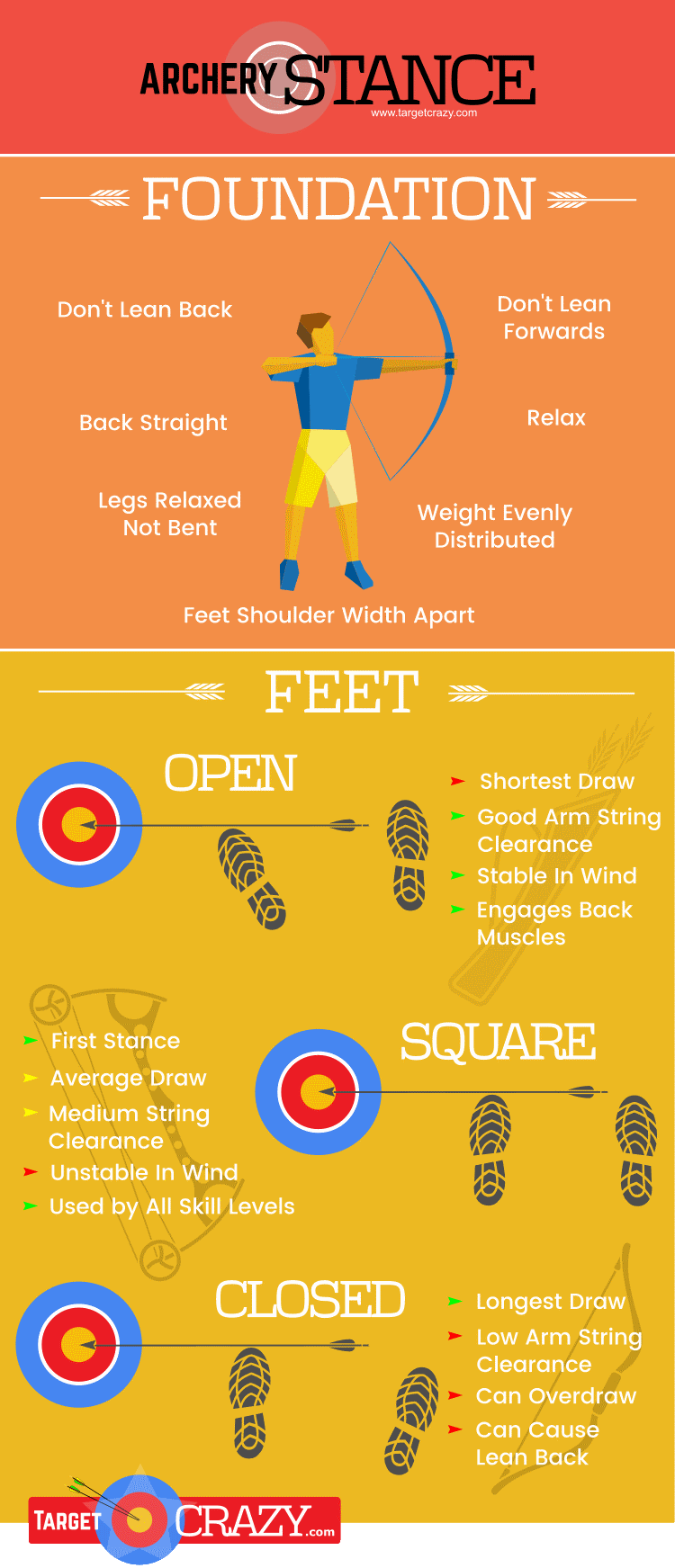
Your stance and grip are the base of every shot. Get them right, and everything else follows.
Adopt an Athletic, Balanced Stance
Stand like an athlete ready to move, balanced and controlled.
- Feet shoulder-width apart
- Front foot pointed at target; back foot at 45-degree angle
- Weight slightly forward on front foot
- Knees soft, not locked
- Lean from hips, not waist
Pro Tip: Trace your foot positions on cardboard. Use it during early practice until muscle memory kicks in. This stance keeps your body aligned, reduces sway, and improves consistency.
Use a Relaxed, Torque-Free Grip
How you hold the bow affects arrow flight more than you think.
- Hold the bow like signaling “stop,” palm forward, thumb at 45 degrees
- Rest the grip between the heel of your hand and your wrist
- Fingers relaxed and curled under, not gripping tightly
Common Mistake: White-knuckle gripping twists the riser and causes inaccurate shots. Think of pushing the bow gently forward, like holding back a curious animal. Let your bones support the weight, not your muscles.
Draw Smoothly with Proper Form
Drawing the bow isn’t about arm strength. It’s about using your back.
Follow a Fluid Draw Motion
- Raise both arms together toward the target
- Keep bow arm straight but slightly bent at the elbow
- Pull the string straight back without lifting or dipping
- Use back muscles (rear deltoids and rhomboids), not your arms
Mirror Principle: Bow hand thumb up at 45 degrees, release hand thumb down at 45 degrees. This symmetry creates a natural draw path. If you can’t reach full draw comfortably, lower the draw weight. Form comes before force.
Anchor Consistently Every Time
Your anchor point is where your hand touches your face at full draw. It must be identical on every shot.
Use Multiple Anchor Points
Top archers use multi-point anchoring for maximum consistency.
- Jawbone: Corner of jaw between index and middle fingers
- Ear: Knuckle or thumb touching earlobe
- Nose: Tip of nose touches the string (Levi Morgan’s method)
- Mouth: String crosses corner of mouth
Pro Tip: The nose-to-string touch confirms head position. No touch means your head is off. Peep sight height should be set so your eye aligns naturally when anchored.
Aim with Precision
Now that you’re anchored, it’s time to aim.
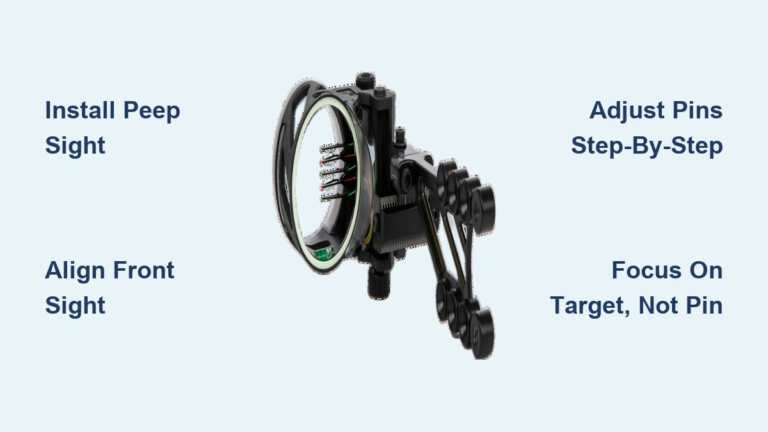
Center the Pin in the Peep Sight
- Look through the peep sight (small hole in string)
- Align it with your front sight pin
- Focus on centering the entire round pin guard, not just one pin
Why this works: Ring-within-a-ring alignment is faster, more consistent, and more forgiving. Use a 1/4-inch peep for hunting because it lets in more light in low-light conditions.
Build a Repeatable Sight Picture
- Start aiming above the target, then slowly lower the pin
- Focus on a tiny spot: aim small, miss small
- Use natural reference points like the crease behind your leg, shoulder bone, or tree limb
Don’t overthink it. Your subconscious handles fine adjustments. Just stay relaxed and consistent.
Choose the Right Release Technique
There are three main ways to release the string. Pick one based on your goals.
Command-Style Release (Best for Hunting)
Also called trigger punching, this method is intentional and controlled.
When to use it:
- Under pressure
- When you have short time to shoot
- To prevent target panic
How to do it:
- Draw and aim at 10 to 15 yards
- Lightly rest finger on the trigger
- Maintain 30 percent push (bow arm) and 70 percent pull (back)
- Fire as the pin passes center
- Visualize the arrow hitting perfectly
Tim Ghillingham, IBO 3D World Champion, says don’t let anyone tell you punching is bad. It’s the only way to shoot for hunting. Use an index-style release for this method.
Surprise Release (Best for Target Shooting)
The shot breaks unexpectedly with no anticipation.
How it works:
- Float the pin over the target
- Focus 100 percent on the bullseye
- Squeeze trigger slowly until release fires
- The shot should come as a surprise
Levi Morgan explains that he drills down on aiming, then lets the release happen automatically. Best with thumb-style or hinge releases. Index triggers require more discipline.
Back Tension Release (For Advanced Archers)
This method uses back muscles to fire the shot.
How it works:
- After anchoring, squeeze shoulder blades together
- Increased tension trips the release
- Eliminates trigger finger involvement entirely
Three-week training plan:
- Week 1: Stand 2 feet from target, eyes closed, practice back squeeze
- Week 2: Open eyes, shoot 30 to 40 arrows at 15 to 20 yards
- Week 3: Extend to 30 yards, focus on mental burn-in
This is not recommended for beginners. It requires strong back muscles and patience.
Follow Through: Let the Shot Finish
Your shot isn’t over when the arrow leaves.
Hold Your Form Until Impact
- Keep bow arm extended
- Maintain anchor point
- Let the bow fall forward naturally. Don’t grab or pull it down.
Mistake: Dropping the bow arm early alters arrow flight. Levi Morgan says if your form is correct, follow-through happens automatically. Watch where the bow settles after release. Consistent follow-through means consistent groups.
Practice Like a Pro
Practice isn’t just shooting arrows. It’s deliberate, focused repetition.
Start Close, Then Go Long
- Begin at 10 yards to build confidence and consistency
- Shoot 3 to 4 arrows per set, then retrieve
- Gradually increase to 20, 30, 50 plus yards
Pro Strategy: To shoot well at 30 yards, practice regularly at 40 to 50 yards. It exposes tiny flaws.
Simulate Real Hunting Conditions
- Wear full gear: gloves, camouflage, arm guard
- Practice drawing with gloves on
- Shoot from uneven ground or elevated stands
- Have a friend call out targets randomly
Jim Dougherty sums it up: we do all this for just one shot. Train under pressure because opening day won’t be perfect.
Try First-Arrow Focus Sessions
- Shoot only 1 to 3 arrows per outing
- Treat each like your only chance on game
- This builds mental toughness and reveals true habits
Fix Common Mistakes Fast
Even small errors ruin accuracy. Here’s how to fix them.
Inconsistent Anchor
- Set peep height so eye aligns naturally
- Use nose-to-string contact as feedback
- Practice anchoring blindfolded
Shaky Bow Arm
- Slightly bend elbow, don’t lock it
- Relax muscles. Tension kills stability.
- Reduce draw weight if needed
Flinching or Target Panic
- Switch to surprise release
- Shorten release stem to reduce finger sensitivity
- Do eyes-closed drills to reset muscle memory
Broadheads Missing
- Shoot broadheads regularly
- Confirm they group with field points
- Tune your bow if impact points differ
Quick Fix List:
- Check draw length
- Lighten draw weight
- Relax bow arm
- Use multi-point anchor
- Practice follow-through
Frequently Asked Questions About Shooting a Compound Bow
What draw weight should a beginner use for compound bow?
Beginners should start with a draw weight between 30 and 50 pounds. Test by drawing and holding for 20 seconds. If you shake or struggle, go lighter. The goal is to build correct form first, then increase weight gradually as your strength develops.
How do I know if my compound bow fits me properly?
Your bow fits properly when you can anchor naturally with the peep sight aligned to your eye. The draw length must match your wingspan (wingspan divided by 2.5). You should be able to hold at full draw without shaking or tilting your head. Get professionally fitted at an archery shop for best results.
What is the best release technique for hunting?
Command-style release (trigger punching) works best for hunting. It’s intentional and controlled, ideal under pressure with limited time to shoot. It prevents target panic and gives you consistent accuracy within 50 yards. Use an index-style release for this method.
How far should a beginner shoot a compound bow?
Start at 10 yards. Build confidence and consistency there before gradually increasing to 20, 30, and 50 plus yards. Pro tip: to shoot well at 30 yards, practice regularly at 40 to 50 yards. Longer distances magnify small errors and help refine your technique.
Why does my arrow hit differently than where I aim?
This usually stems from inconsistent anchor point, improper sight alignment, or broadheads not tuned to match field points. Check that your peep sight is properly aligned with your eye, verify your anchor point is identical every shot, and periodically shoot broadheads to confirm they group with your field points.
How often should I practice shooting my compound bow?
Practice 30 to 50 quality arrows per session rather than 100 rushed ones. Stop when fatigued because bad reps reinforce bad form. Practice in conditions that mimic hunting: wear gloves, shoot from odd distances, and simulate pressure situations.
Key Takeaways for Shooting a Compound Bow
Mastering how to shoot a compound bow for beginners comes down to three things: proper setup, consistent form, and deliberate practice. Set your draw length and weight to match your body. Use a relaxed grip and athletic stance. Anchor identically every single shot. Choose a release method that matches your goal, whether hunting or target shooting.
The most important habit to build is follow-through. Hold your form until the arrow hits the target. Don’t drop your bow arm early. These small details separate accurate archers from inconsistent ones.
Start at 10 yards, master the fundamentals, then gradually extend your range. Practice under pressure because hunting conditions won’t be perfect. Most of all, enjoy the journey. Archery is a skill that compounds over time. The more you shoot with intention, the faster you’ll improve.
Grab your bow, check your setup, and take your first perfect shot one repeatable step at a time.