How to Calculate Bow Speed
You’ve seen the advertisements: “This bow shoots 350 fps!” But when you string up your hunting gear and fire, the arrow feels noticeably slower—and it is. Most manufacturer-rated speeds are measured under ideal laboratory conditions that don’t reflect real-world archery. To know your true arrow speed, you need to measure it directly or calculate it using your exact setup. Bow speed, measured in feet per second (fps), directly affects trajectory, kinetic energy, and downrange performance. Whether you’re hunting big game or competing in 3D archery, understanding your actual arrow speed is essential for ethical kills and accurate shooting.
This guide covers every reliable method for determining bow speed, from chronograph measurement to audio timing and video analysis. You’ll learn how to adjust manufacturer IBO ratings for your specific draw length, arrow weight, and accessories, and discover why most hunters shoot 20 to 50 fps slower than advertised. Plus, you’ll see how to use speed data to calculate kinetic energy and momentum for optimal performance.
Measure Arrow Speed with a Chronograph
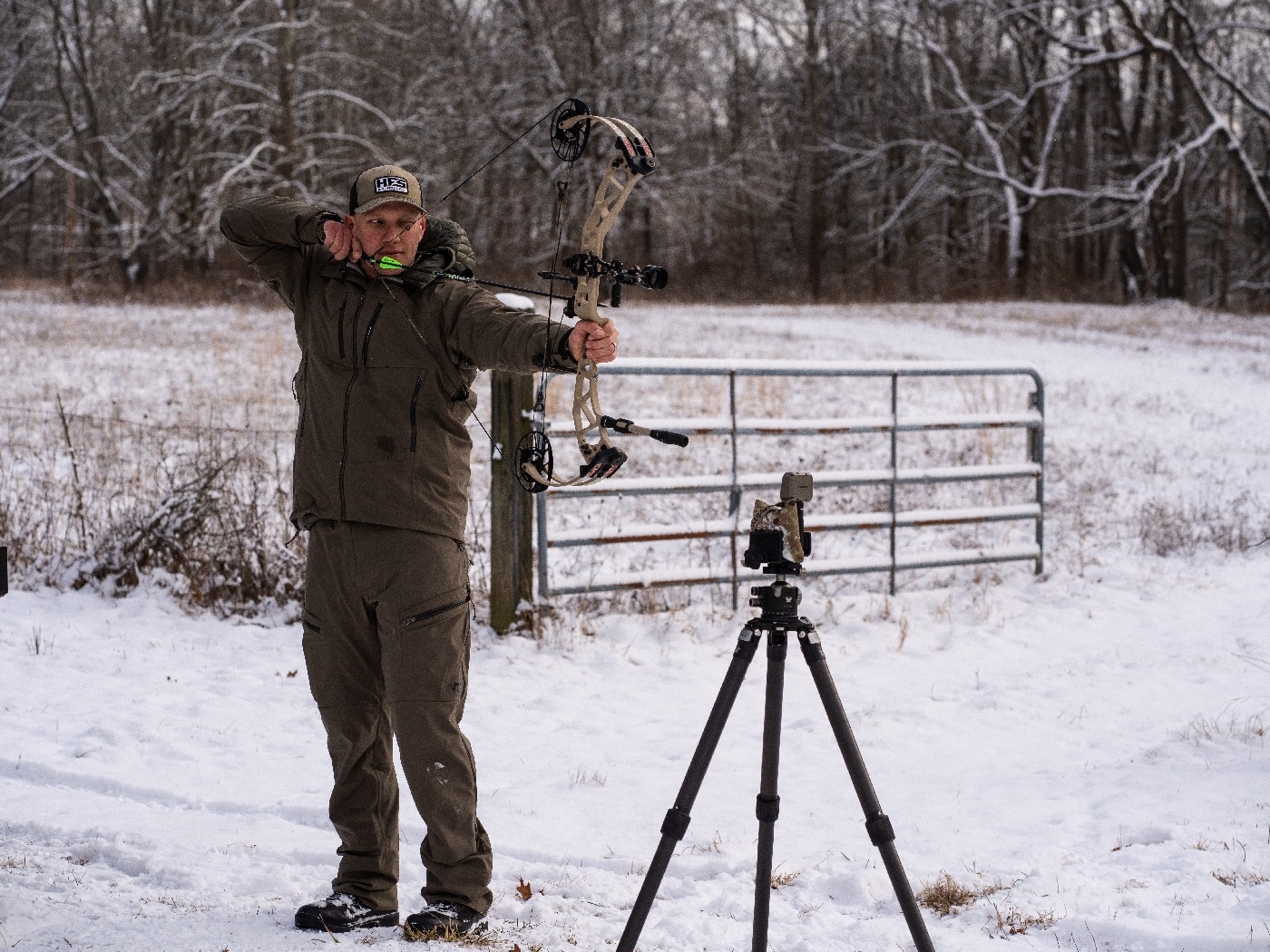
The most accurate way to determine bow speed is direct measurement using an electronic chronograph. These devices use infrared or optical sensors spaced a known distance apart to capture arrow velocity in real time. The chronograph calculates speed by timing exactly how long the arrow takes to pass between the sensors.
Set Up Your Chronograph Correctly
Place the unit 3 to 6 feet in front of the shooting line, ensuring it’s aligned with your arrow’s flight path. The arrow must pass cleanly through the sensor field for an accurate reading. High-end models like the Techno-Hunt offer plus or minus 1 fps accuracy and are used in professional archery shops for precise tuning. Entry-level chronographs from brands like Caldwell, Tipton, and LaserChronics start at $65 to $70 on Amazon and deliver reliable results for most users.
Avoid testing in bright sunlight if using optical chronographs, as glare can interfere with sensor accuracy. Level the unit to prevent skewed readings, and ensure consistent lighting conditions throughout your testing session.
Test with Your Complete Hunting Setup
Always test with your full arrow setup: shaft, nock, fletching, insert, and your chosen point or broadhead. Switching from a field point to a mechanical broadhead can alter speed due to differences in aerodynamics. Take 5 to 10 shots and average the results, discarding any outliers caused by poor form or equipment slip. A bow rated at 300 fps may only shoot 270 to 275 fps with a 400-grain hunting arrow. Only a chronograph reveals the truth about your actual arrow speed.
Visit an Archery Shop for Lab-Grade Accuracy
If you don’t own a chronograph, many pro shops offer testing for a small fee. They often use professional-grade units that provide more consistent readings than budget models. This option is especially useful when tuning a new bow or verifying performance after changing draw weight or arrow length.
Calculate Bow Speed Using Audio Recording
No chronograph? No problem. You can measure bow speed accurately using your smartphone and a simple physics approach that uses sound to calculate flight time over a known distance.
Gather Your Materials
You’ll need a tape measure (not a rangefinder, which has margin of error), a smartphone with voice memo or audio app, and audio editing software like Ocenaudio or Audacity. Set up a 60-foot measured distance from the arrow tip at full draw to the target face. Place your smartphone at the 30-foot midpoint to balance sound delay from both the release and the impact.
Record and Analyze the Shots
Record multiple shots while capturing both the bowstring release sound and the arrow hitting the target. In your audio software, zoom into the waveform to identify the start of each peak. Read the time difference between them with precision to 1 millisecond. Apply the speed formula: Speed (fps) equals 60 divided by flight time in seconds. For example, a flight time of 0.214 seconds gives you 60 divided by 0.214, which equals 279.4 fps. Average 5 to 6 shots to minimize error from human timing or inconsistent draws.
With careful setup, this method matches chronograph results within 1 to 2 fps.
Estimate Speed with Video Frame Analysis
Use slow-motion video to visually track arrow movement and calculate speed based on frame count. This method works well for visual learners who have cameras with true fixed frame rates.
Set Up Reference Markers
Install a wall, fence, or backdrop with 1-foot or 1-meter markings at a known distance, such as 10 meters. Shoot parallel to the markers so the arrow passes in front of them. Film from the side, exactly 90 degrees to the flight path, for accurate tracking.
Record and Calculate Using Frame Count
Record in slow motion with a true fixed frame rate, such as 240 fps. Many smartphones automatically adjust frame rate based on lighting conditions, which invalidates timing data. Count how many frames the arrow takes to travel between two marks, then calculate time by dividing the frame count by the frame rate. Calculate speed by dividing distance by time.
For example, if an arrow travels 3 feet in 9 frames at 240 fps, the time equals 9 divided by 240, which is 0.0375 seconds. Speed equals 3 divided by 0.0375, giving you 80 fps at that distance. Repeat across multiple shots and average your results.
Understand IBO and ATA Speed Ratings
Manufacturers rate bows using standardized tests called IBO and ATA. Understanding these ratings helps you set realistic expectations for your equipment.
IBO Standard Conditions
IBO (International Bowhunting Organization) tests bows under specific conditions: 30-inch draw length, 70-pound draw weight, 350-grain arrow weight, and no accessories (no peep sight, silencers, D-loop, or string attachments). A bow advertised at 350 fps IBO only reaches that speed under these exact conditions.
ATA Standard Is Nearly Identical
ATA (Archery Trade Association) uses the same parameters: 30-inch draw, 70-pound draw weight, and 350-grain arrow. Results are generally interchangeable with IBO ratings. Both standards are laboratory benchmarks, not real-world guarantees. Most hunting setups fall short due to shorter draw lengths, heavier arrows, and added string weight. A 350 fps IBO bow may shoot 280 to 310 fps in the field.
Adjust IBO Speed for Your Actual Setup
Since few archers shoot at IBO specifications, use adjustment rules to estimate your actual speed. These formulas account for the differences between lab conditions and your real-world setup.
Modify for Draw Length
Every inch under 30 inches reduces speed by 10 to 15 fps. Every inch over adds 10 to 15 fps. For example, a 28-inch draw length is 2 inches shorter than standard, resulting in a reduction of 20 to 30 fps.
Adjust for Draw Weight
Every 10 pounds below 70 reduces speed by 15 to 20 fps. Use 18 fps per 10 pounds as a reliable average. For example, a 60-pound draw weight is 10 pounds less than standard, resulting in an 18 fps reduction.
Account for Arrow Weight
For every 5 grains over 350, subtract 1 to 2 fps. Modern bows lose about 1 fps per 5 grains of added arrow weight. For example, a 400-grain arrow is 50 grains heavier than standard, resulting in a 10 fps reduction. Heavier arrows slow the bow, while lighter arrows increase speed but reduce momentum.
Deduct for String Accessories
Every 3 grains added to the string reduces speed by 1 fps. Typical string accessories (peep sight, silencers, D-loop) add 15 to 45 grains, costing you 5 to 15 fps of speed.
Use the Full Adjustment Formula
Combine all factors into one equation to estimate your speed. The formula is: Estimated Speed equals IBO minus (10 times the absolute difference between 30 and your draw length) minus (2 times the absolute difference between 70 and your draw weight) minus (arrow weight minus 350 divided by 5) minus (string weight divided by 3).
Example Calculation
For a bow with 325 fps IBO, 30.5-inch draw length, 58-pound draw weight, 414-grain arrow, and 30-grain string accessories: draw length adds 5 fps (0.5 inches over times 10), draw weight subtracts 21.6 fps (12 pounds under times 1.8), arrow weight subtracts 12.8 fps (64 grains over divided by 5), and string weight subtracts 10 fps (30 divided by 3). The total is 325 plus 5 minus 21.6 minus 12.8 minus 10, giving you approximately 286 fps.
Calculate Kinetic Energy and Momentum
Speed alone doesn’t tell the full story. Use your arrow speed to calculate kinetic energy and momentum, which determine penetration and ethical killing power.
Find Kinetic Energy in Foot-Pounds
The formula is KE equals arrow weight times speed squared divided by 450240. For example, a 400-grain arrow at 300 fps produces (400 times 90,000) divided by 450240, which equals approximately 80 ft-lbs of kinetic energy. For medium game, target 25 to 41 ft-lbs. For large game, aim for 42 to 65 ft-lbs. For elk or moose, you’ll need 66 or more ft-lbs.
Compute Momentum in Slug-Feet-Per-Second
The formula is momentum equals arrow weight times speed divided by 225218. For example, 400 grains times 300 fps equals 120,000, divided by 225218 gives you approximately 0.533 slug-fps. For medium game, target 0.207 to 0.305 slug-fps. For large game, aim for 0.349 to 0.433 slug-fps. For the toughest game, you’ll need 0.481 or higher.
Kinetic energy favors speed (since velocity is squared), so fast arrows look good on paper but may lack penetration. Momentum reflects penetration potential, so favor heavier arrows for deep hits on big game.
Track Downrange Speed Loss
Arrows slow down significantly due to air resistance. Understanding this decay helps you assess lethality at extended ranges.
Factors That Increase Drag
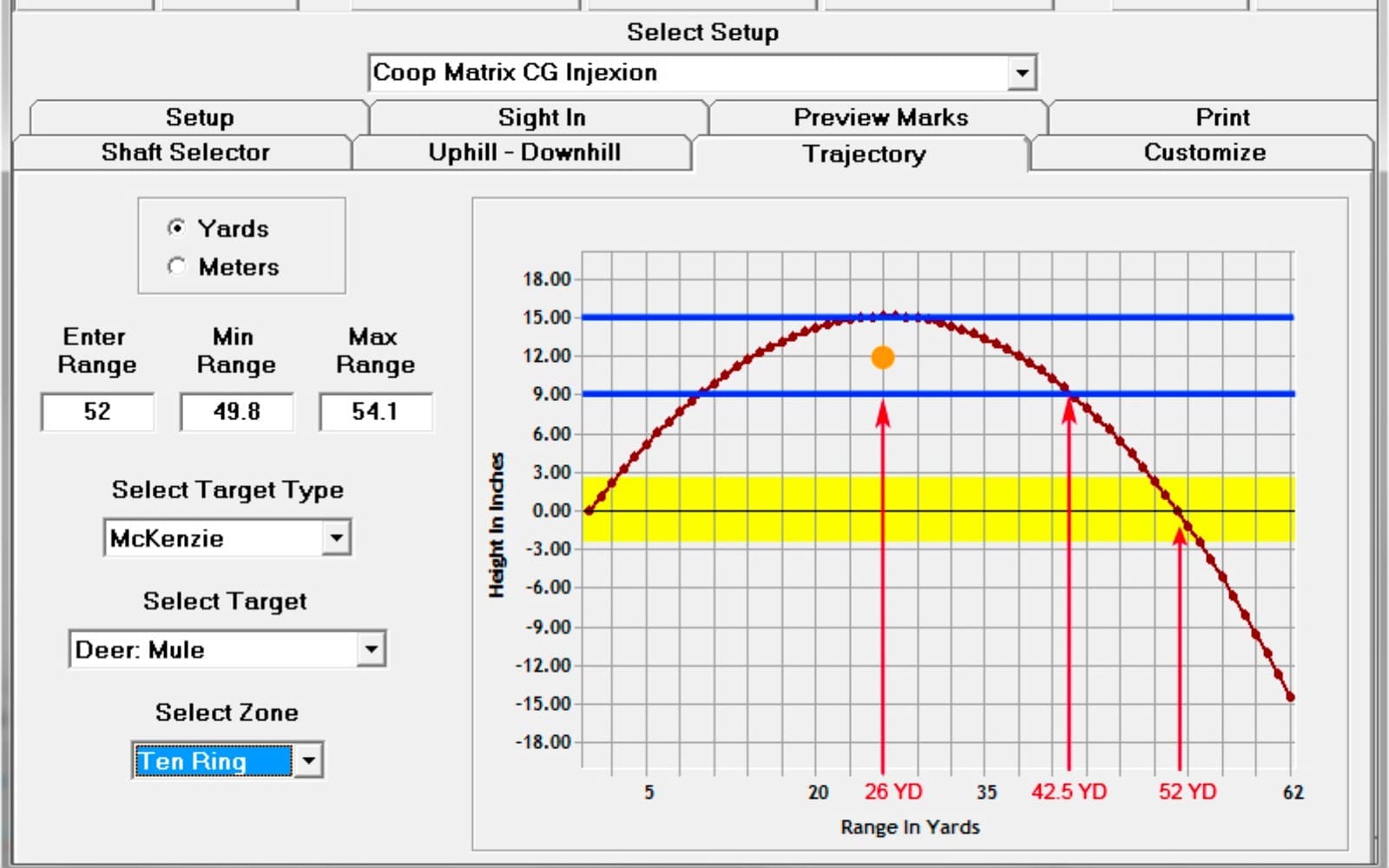
Large-diameter shafts, oversized vanes or feathers, mechanical broadheads, wind, and humidity all increase drag and reduce speed. A 450-grain arrow at 259 fps may drop to 219 fps at 40 yards, which is a 15% loss. Use online ballistics calculators like Hunters Friend or BowSim to model decay based on your arrow diameter, fletching type, broadhead style, and target distance.
Why Bow Speed Matters for Hunting and Competition
Understanding bow speed affects your equipment choices and shooting performance in tangible ways.
For Competition Archers
Some 3D archery classes cap speed at 290 fps. Exceeding this limit means disqualification. Accurate measurement ensures compliance with class regulations and helps you stay within legal limits.
For Hunters
A faster arrow provides a flatter trajectory, which means less guesswork at unknown distances. Shorter time of flight reduces the chance of flinching or animal movement before impact. However, too light an arrow sacrifices penetration. A fast arrow has the flattest trajectory possible, which is a good thing for several reasons, the biggest being the leeway in aiming at a distant target at an unknown range. Balance speed with energy and ethical performance.
Best Methods for Calculating Bow Speed
Choose the method that fits your needs and equipment access.
| Method | Best For | Accuracy |
|---|---|---|
| Chronograph | Most accurate; essential for tuning | Highest |
| Audio Timing | Free, precise alternative to chrono | Very high |
| Video Analysis | Visual learners with fixed-frame cameras | Moderate |
| IBO Adjustment | Pre-purchase estimates | Moderate |
| Corrected IBO | Refining predictions with real data | High |
Frequently Asked Questions About Calculating Bow Speed
How do I calculate my bow speed without a chronograph?
You can calculate bow speed using audio recording or video analysis. The audio method requires a 60-foot measured distance, a smartphone, and audio editing software. Record the release sound and impact, then measure the time difference between them. Divide 60 by the flight time in seconds to get your speed. This method can match chronograph results within 1 to 2 fps with careful setup.
What is the IBO speed rating and how does it relate to actual speed?
IBO (International Bowhunting Organization) speed rating measures bow speed under specific test conditions: 30-inch draw length, 70-pound draw weight, 350-grain arrow, and no accessories. A bow rated at 350 fps IBO only achieves that speed under these exact conditions. Most hunters shoot 20 to 50 fps slower than the IBO rating because their setups differ from the test conditions.
How does arrow weight affect bow speed?
Every 5 grains of added arrow weight reduces speed by 1 to 2 fps. A 400-grain arrow versus a 350-grain standard will cost you approximately 10 to 20 fps of speed. Heavier arrows slow the bow but increase momentum and penetration, which is often preferable for hunting larger game.
What is the formula to adjust IBO speed for draw length?
For every inch under 30 inches of draw length, subtract 10 to 15 fps. For every inch over 30 inches, add 10 to 15 fps. For example, a 28-inch draw length (2 inches shorter than standard) reduces speed by 20 to 30 fps.
How do I calculate kinetic energy from bow speed?
Use the formula KE equals arrow weight times speed squared divided by 450240. For a 400-grain arrow at 300 fps, the calculation is (400 times 300 squared) divided by 450240, which equals approximately 80 ft-lbs. This tells you the energy available for penetration at impact.
Key Takeaways for Calculating Your Bow Speed
Knowing your actual arrow speed requires either direct measurement with a chronograph or calculation using adjustment formulas based on your specific setup. Manufacturer IBO ratings represent idealized laboratory conditions, not real-world performance. Most hunting setups produce speeds 20 to 50 fps lower than advertised due to shorter draw lengths, heavier arrows, and string accessories. Use the full adjustment formula to estimate your speed before purchasing or changing equipment. Combine theoretical calculations with real-world testing for the most accurate results. Test with your complete hunting arrow, including broadhead, not just field points. Optimize arrow weight for your draw weight, aiming for approximately 5 grains per pound. Consider kinetic energy and momentum, not just speed, when evaluating hunting performance. The best arrow isn’t the fastest or heaviest, it’s the one that allows your bow to use stored energy most efficiently for your intended game.