How to Use Bow Sights: A Simple Guide
If your arrows keep missing the mark despite consistent form, the issue might not be your technique. Learning how to use bow sights transforms scattered shots into tight groups and predictable accuracy. Bow sights account for arrow drop, giving you precise aiming points at specific distances. Without one, you’d rely on guesswork, which limits your effectiveness beyond 30 yards.
This guide walks you through every step of bow sight usage, from installing your peep sight to fine-tuning pins at 60 yards. You’ll understand not just how to adjust your sight, but why each adjustment matters, and how to avoid common mistakes that waste time and frustrate progress.
Why Bow Sights Transform Your Accuracy
Arrows don’t fly in a straight line. They follow a curved path due to gravity, dropping significantly over distance. At 20 yards, this drop is minimal, but at 50 yards, your arrow might fall over a foot below where you aimed. Bow sights eliminate this guesswork by providing preset pins for specific yardages.
Unlike rifle scopes, bow sights must be personalized to your body and shooting style. Your draw length, anchor point, eye position, and even hand torque all influence where your pins need to be set. Even with identical gear, two archers will require different sight settings. This is why you can’t borrow someone’s sighted-in bow and expect it to work for you.
Sights give you repeatable aiming points that turn instinct into precision. Once properly set, you can aim directly at your target and trust the pin to compensate for arrow drop. A well-sighted bow can place shots within inches of the bullseye at 60 yards, even in challenging light conditions.
Essential Components of a Bow Sight System

Every accurate shot requires two parts working together: the front sight and the rear peep sight.
Front Sight (Sight Housing)
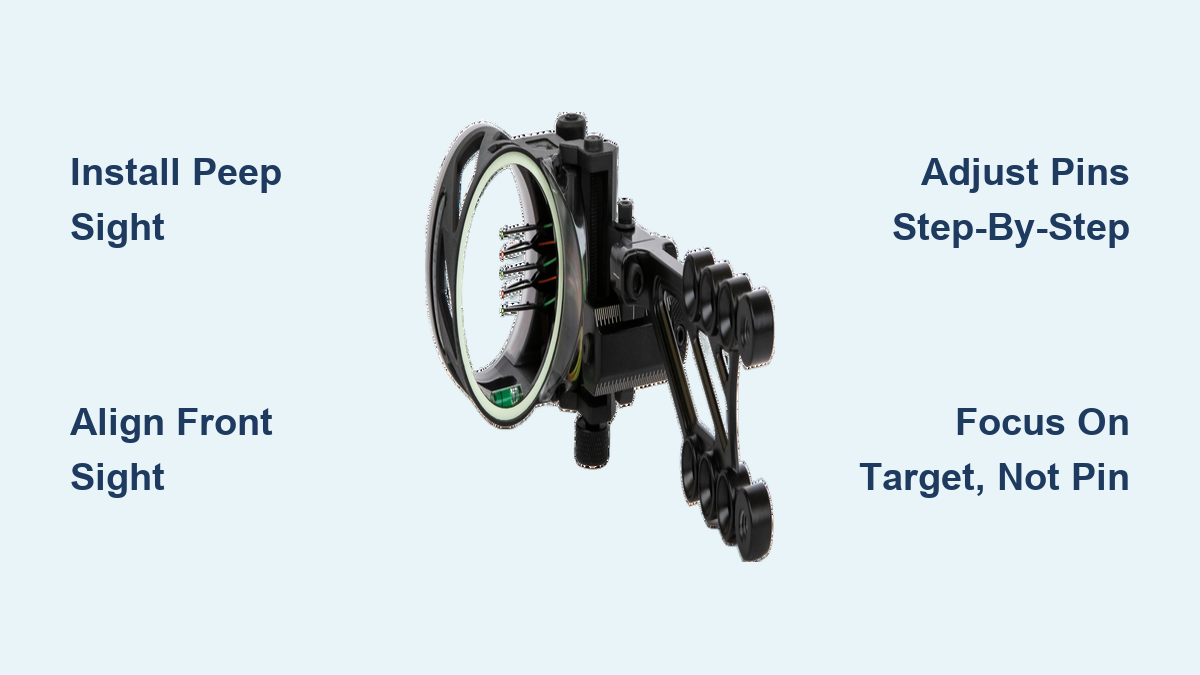
The front sight mounts on your bow’s riser and contains adjustable pins set for specific distances. Most compound bow sights use multiple pins, typically configured for 20, 30, 40, 50, and 60 yards. The round housing creates a visual frame that helps you center the pin consistently.
Key features include fiber-optic pins that gather ambient light for better visibility, elevation adjustment for vertical changes, and windage adjustment for horizontal corrections. The sight ring provides a consistent boundary that improves aiming repeatability.
Rear Peep Sight
The peep sight is a small ring installed in your bowstring. It acts as a rear aperture, aligning your eye, the front sight, and the target in a straight line. This ensures consistent head position and anchor point, which is essential for accuracy beyond 30 yards.
Peep sizes typically range from 1/8 inch to 3/16 inch. Smaller diameters offer tighter precision but can be harder to see through in low light. Larger diameters provide a wider field of view but slightly less precision. A kisser button alone cannot replace a peep sight since it provides no visual alignment.
Tools Needed for Bow Sight Setup
Before beginning, gather these essential tools:
- Allen wrench set for adjusting pins and housing
- Bow press for installing or adjusting the peep sight
- String serving material to secure the peep in place
- Targets placed at 10, 20, 30, 40, 50, and 60 yards
- Consistent arrows with matching weight, spine, and length
- Bubble level to prevent bow canting
- Rangefinder to confirm exact distances
- Shooting rest for stability during tuning
Always use field points, not broadheads, when sighting in. Broadheads fly differently and can ruin your tuning process.
How to Install and Align Your Peep Sight
The peep sight forms the foundation of your aiming system. If it’s misaligned, your entire sight picture will be off.
Installing the Peep
Place your bow in a bow press. Slide the peep onto the string near the center, then serve it in place using string material. Using a two-tone bowstring makes finding the exact center easier.
Aligning for Your Anchor
Draw the bow and anchor normally. Rotate the peep until it frames the front sight ring evenly. Shoot several arrows to let the string settle. If the peep rotates inconsistently, return to the bow press and add or remove half-twists in the string until alignment stabilizes.
Once properly set, a peep can stay aligned for years, especially with pre-stretched strings.
Mounting Your Front Sight Correctly

With your peep in place, install the front sight on the riser using the mounting bracket. Keep screws slightly loose for initial alignment.
Nock an arrow and look down the bow. Align the middle pin with the bowstring and nock. It’s normal for the pin to sit slightly left of the arrow shaft on right-handed bows. Center the middle pin in the housing for balanced aiming.
Choosing the Right Sight Type and Pin Configuration
Most archers use multi-pin compound bow sights. Here’s how to choose:
5-Pin Sights (Most Popular)
These set pins for 20, 30, 40, 50, and 60 yards. Ideal for hunting where quick target acquisition matters at various distances.
3-Pin Sights
Configured for 20, 40, and 60 yards. These provide a cleaner sight picture but require gap shooting between pins.
Custom Spacing
High-speed bows (300+ fps) with flatter trajectories can use wider spacing, such as 30, 40, 50, 60, and 70 yards.
Step-by-Step Process for Sighting In Your Bow
Follow this proven sequence for accurate results.
Starting at 10 Yards
Begin at 10 yards to catch major alignment errors safely. Use a T-shaped tape on your target. The vertical line helps fix left/right issues, while the horizontal line corrects high/low problems.
Shoot three-arrow groups, not single shots. Ignore outliers caused by poor releases. Move the sight housing in the same direction as your group. Arrows grouping left means move sight left. Arrows high means move sight up.
If your top pin is for 20 yards, aim a few inches high at 10 yards. If it’s for 30 yards, aim dead center.
Setting Your Top Pin Distance
Move to your top pin distance (20 or 30 yards). Adjust the entire sight housing until your group centers on the bullseye. Retighten all screws after making changes.
Setting the 30-Yard Pin
The 30-yard pin serves as your reference point. Once set, all other pins adjust relative to it. Shoot with the 30-yard pin and adjust the housing until perfectly centered.
Adjusting 40, 50, and 60-Yard Pins
Now only adjust individual pins, not the housing. If the 40-yard pin hits above the target, lower the pin. Same logic applies to 50 and 60-yard pins. Make small adjustments and re-shoot after each change.
Understanding Sight Adjustment Logic
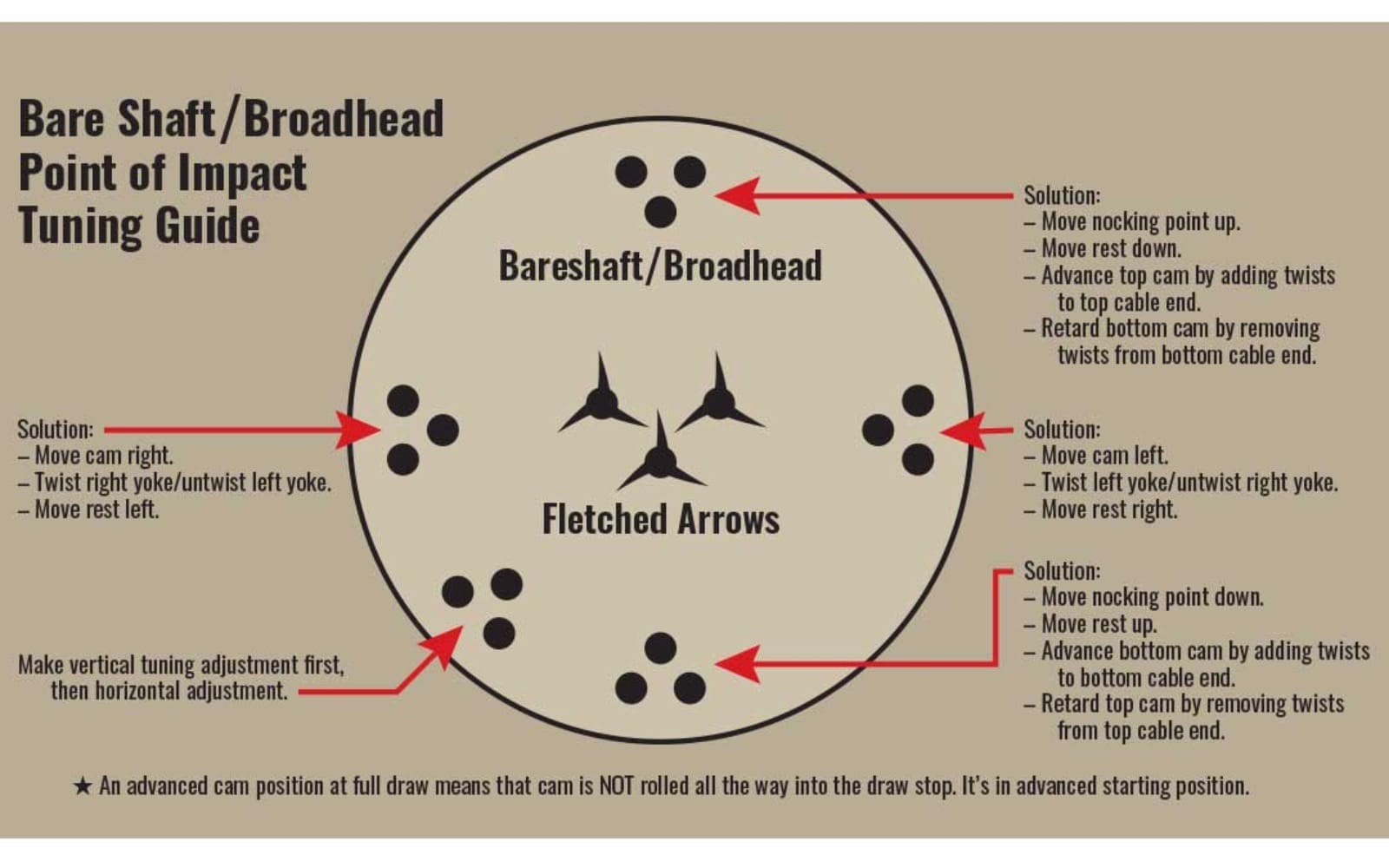
Use this simple chart for corrections:
| Arrow Impact | Fix By Moving Sight |
|---|---|
| High | Up |
| Low | Down |
| Left | Left |
| Right | Right |
This differs from rifle scopes where you move the sight opposite the bullet impact. With bow sights, move in the same direction as the miss.
Vertical adjustments require loosening the elevation screw and shifting the housing. Horizontal adjustments require loosening the windage screw and sliding left or right. Always retighten screws after adjustment.
A tight grip causes left and right misses. Focus on relaxing your bow hand.
Where to Focus: Target or Pin
This concept changes everything for archers.
Focus on the Target
Your eyes should lock on the target, not the sight pin. The pin will appear blurry, which is correct. Your brain uses peripheral vision to center the pin naturally.
Why Not Focus on the Pin
Your eyes cannot focus on two distances simultaneously. The pin sits 24 to 30 inches away, while the target is 20 or more yards distant. Focusing on the pin blurs the target, reducing your ability to judge distance and alignment accurately.
Avoid Tracking the Pin
The pin will wobble during draw due to natural muscle movement. Trying to steady it causes jerky releases. Let the pin float and trust your form to align it subconsciously.
Best Practices for Consistent Accuracy
Form Before Sight Adjustment
If arrows scatter, it’s a form issue, not a sight problem. Fix inconsistent anchor points, poor releases, or tension in your bow hand before adjusting the sight. Only tune the sight once arrows group tightly, even if off-center.
Be Patient and Consistent
Sighting in takes multiple sessions. Form changes slightly day to day. Let the bow settle, especially new strings or cams. Spread tuning over three to five days for best results.
Avoid Shooting Fatigued
Tired muscles cause low, erratic shots. If you’re exhausted, your form deteriorates, and you might incorrectly adjust the sight to compensate. Stop when tired and resume when rested.
Make Small Adjustments
A tiny turn of the Allen wrench can move the pin an inch at 40 yards. Over-adjusting leads to chasing the bullseye endlessly. Re-shoot after each small change.
Maintaining Your Sight Long-Term
A properly maintained sight can hold zero for years.
Check and tighten all screws monthly. Inspect the peep for rotation or wear. Recheck alignment after string replacement, extreme temperature changes, or long storage periods. Use shock-absorbing sights to reduce vibration and maintain precision.
Common Mistakes to Avoid
Many archers waste time by making these errors:
Adjusting after every shot instead of waiting for three-arrow groups. Ignoring peep alignment. Using mixed arrows with different weights or spines. Over-gripping the bow. Skipping the 30-yard pin as your reference. Shooting on slopes instead of flat ground. Relying on single arrows instead of groups. Sighting in while fatigued. Starting at long range instead of 10 yards. Making large adjustments instead of small ones. Skipping paper tuning before sighting in. Focusing on the pin instead of the target.
Frequently Asked Questions About How to Use Bow Sights
What distance should I sight my top pin at?
Most hunters set their top pin at 20 or 30 yards. The 30-yard pin serves as the most common reference point because it represents the mid-range sweet spot for most hunting scenarios.
How do I know if my bow needs sighting in?
If your arrows consistently group together but miss the bullseye, your bow needs sighting. If arrows scatter randomly across the target, the issue is form, not sight alignment.
Can I use my bow sight with a recurve bow?
While recurve bows can use sights, they are most common with compound bows. Recurve archers often rely more on instinctive aiming or simple string aids.
Why does my peep sight rotate when I shoot?
Peep rotation indicates string twist issues. Return the bow to a press and add or remove half-twists until the peep stays aligned after shooting.
Should I focus on the target or the sight pin?
Focus on the target. The pin should appear blurry in your peripheral vision. This allows your brain to center the pin naturally while maintaining target awareness.
How long does it take to sight in a bow properly?
Plan for multiple sessions over three to five days. Rushing leads to poor results. Allow time for the bow to settle and for you to maintain consistent form.
Key Takeaways for Mastering Bow Sights
Bow sights transform archery from guesswork into precision. The process starts with proper peep sight installation, followed by front sight mounting, then systematic sighting at increasing distances. Always begin at 10 yards to catch major errors, then work outward.
Remember the critical rule: focus on the target, not the pin. Your sight adjustments should move in the same direction as your arrow group, and always make small changes before re-shooting. The 30-yard pin serves as your anchor, so invest extra time getting it perfect.
Form matters more than sight adjustments. If your shots scatter, fix your technique before touching the sight. Once arrows group tightly, then fine-tune the pins for each distance. With patience and consistent practice, you’ll achieve the confidence that comes from watching arrows hit exactly where you aim.