How to Aim a Bow and Arrow: Simple Steps
You draw the bow, settle into your anchor, and fix your eyes on the target, but where exactly should you aim? Whether you’re hunting in the woods or competing on the range, how to aim a bow and arrow correctly is the key to consistent accuracy. This isn’t just about pointing and shooting. It’s a blend of technique, focus, and repetition, and the method you choose depends on your equipment, discipline, and personal preference. There’s no one-size-fits-all approach, but understanding your options puts you in control.
From instinctive shooting passed down through generations to precision sight systems used in Olympic competition, every archer finds their own path. Some rely on muscle memory and feel. Others use measurable gaps or mechanical pins. The best archers combine solid biomechanics with mental clarity, letting their body do the work while their mind stays locked on the target. This guide covers every major aiming method, the science behind focus and breathing, and how to troubleshoot common mistakes.
Choose Your Aiming Method

Every archer must decide how they aim, but the choice isn’t arbitrary. Your bow type, shooting style, and goals determine the best fit. There are six proven methods, each with strengths and ideal uses. Most archers start with one and evolve based on experience.
Match Method to Discipline
Traditional or longbow shooters typically use instinctive, gap, or floating focus methods. Barebow recurve archers often choose gap shooting or string walking. Olympic recurve competitors rely on sight-based aiming. Compound bow users benefit from precision pin sights. Hunters frequently prefer instinctive, split vision, or gap methods combined with a rangefinder.
No method is better than another, only more suitable for your setup and situation. A hunter tracking deer benefits from fast, fluid instinctive shots. A competitive target shooter gains from the repeatability of a calibrated sight.
Switching methods mid-journey often causes a temporary drop in accuracy. Stick with one long enough to master consistency before changing.
Instinctive Aiming: Trust Your Eyes
This is archery in its purest form. You look at the target and shoot. No measuring, no calculations, no aiming devices. It feels like throwing a ball at a target. You don’t calculate gravity or distance. You just know where to throw.
How to Shoot Instinctively
Focus intensely on a small spot, such as the edge of a deer’s shoulder or the center ring of a target face. Draw, anchor, and release without consciously aligning the bow. Let your brain and body coordinate the shot automatically. With enough repetition, your nervous system learns the correct motor pattern for each range.
When to Use It
Instinctive aiming works best for hunting, field archery, and traditional shooting. The advantages are speed, natural feel, and no gear required. The drawback is that it requires hundreds to thousands of practice shots to develop reliability.
Build Consistency
Use the same arrows, draw length, and anchor point every time. Practice at known distances first, then test at unknown ranges. Grouped misses, where all shots land in the same area, mean your form is consistent. Adjust your aim accordingly rather than your technique.
If your shots are scattered in random directions, the issue isn’t aiming. It’s inconsistent form.
Gap Shooting: Aim With the Arrow Tip
Gap shooting is a precision method for barebow and traditional archers who want control without sights. It uses the vertical distance between your arrow tip and the target as a reference for different ranges.
Understand the Point-On Distance
This is the range where your arrow tip aligns with the point of impact. Closer than that distance, you aim below the target. Farther, you aim above the target. The exact gap depends on your setup, including draw weight, arrow weight, spine, and anchor height.
Create Your Gap Chart
Start at 10 yards and shoot with your arrow tip on the bullseye. Note where the arrow hits. Adjust the tip position until it hits center. This becomes your 10-yard gap. Repeat the process at 20, 30, and 40 yards. Record each hold point in a chart for quick reference during shooting.
Common gap positions include aiming on the lower white ring at 10 yards, on the bullseye at 20 yards, in the upper white ring at 30 yards, and just below the top edge at 40 yards.
Use a Rangefinder
Gap shooting fails without knowing the distance. For hunting or 3D archery, always use a laser rangefinder to determine range, then apply the correct gap. Gaps are personal. Yours won’t match someone else’s, even with the same bow.
String Walking: Finger Position for Distance
String walking is a technical aiming method where you walk your fingers down the string to adjust for range while keeping your anchor point fixed. This method is highly precise when properly calibrated.
How It Works
Your anchor stays fixed, typically under your jaw. Your fingers move below the nocking point, lower for longer distances. Each finger position changes the arrow’s trajectory. The string is often marked with tape or wax for consistency.
Typical finger positions place your fingers at the nocking point for 40 yards, one inch below for 30 yards, two inches below for 20 yards, and three inches below for 10 yards.
Why It Works
String walking is precise because you always aim directly at the target with no off-target holds. It functions like a single-pin compound bow, one setup per distance. Highly accurate results come when the method is properly tuned.
Challenges
This method requires perfect arrow tuning through paper testing and group testing. It’s sensitive to string stretch and humidity. You must know the exact distance, making a rangefinder essential.
Split Vision Aiming: See Target and Tip
Split vision is a hybrid method combining instinct and control. You focus on the target while maintaining peripheral awareness of the arrow tip.
How to Do It
Keep your eyes locked on the bullseye. The arrow tip remains visible in your side vision. Adjust until the sight picture feels right. No measurements are needed, just a learned visual memory of correct alignment.
Advantages
This method is faster than gap shooting and easier to learn than pure instinctive shooting. It maintains shooting rhythm well. However, accuracy drops in poor light or low contrast situations, and it’s hard to standardize across multiple distances.
Floating Focus: Aim Through the Bow
Floating focus is an advanced method for low-anchor traditional shooters where the arrow tip sits too low to aim with directly. It relies on binocular vision and depth perception.
Why It Works
With both eyes open, focus on the distant target. Nearby objects like the bow become transparent or doubled. Your brain merges the images, creating a floating reference point aligned with the target.
Choose a Reference Point
Pick a fixed spot on your bow such as the top limb bolt, a riser screw, or a factory-etched line. At full draw, focus on the target. This point will appear to float over it.
Hold Rules by Distance
For distances 30 yards or less, hold slightly under the target. For distances greater than 40 yards, hold slightly above the target. Continue shifting upward for longer ranges up to 60 yards.
Sight-Based Aiming: Pin, Focus, Release
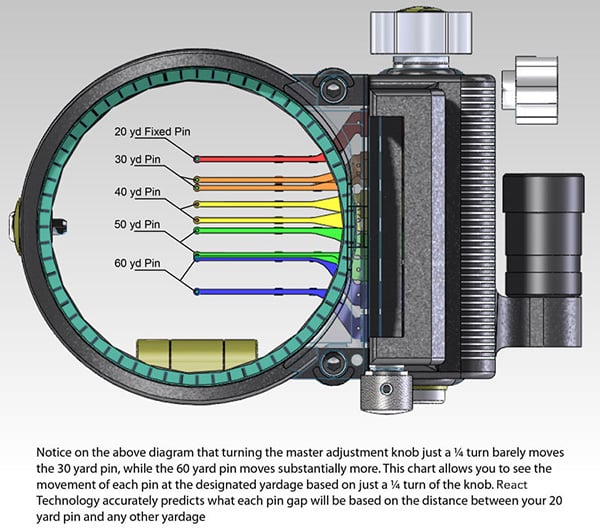
Sight-based aiming is used in Olympic and compound archery for maximum precision. It relies on mechanical sighting systems to align the bow with the target.
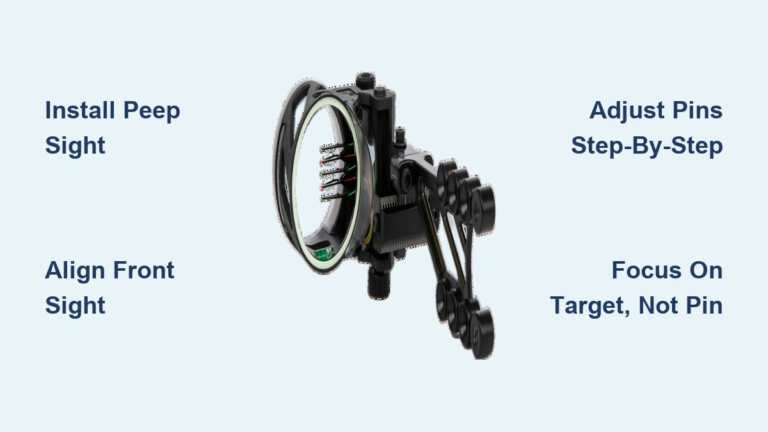
Focus on the Target, Not the Pin
Your eye can only focus on one plane at a time. At distances beyond 10 yards, the target should be sharp and the pin slightly blurry. This is correct. Focusing on the pin blurs the target and ruins accuracy.
Let the Pin Float
The pin will naturally move due to breathing and heartbeat. Don’t fight it. Keep your eyes on the target. Release when the pin passes over the center. Trust your subconscious timing.
Pre-Aim for Consistency
Before drawing, point the bow at a setup point such as two o’clock on the target face. As you draw, the sight rises into the gold. This builds muscle memory for a repeatable draw path.
Master the Mental Game
Aiming is 90 percent mental. Your body executes the shot, but your mind decides where to aim.
Conscious vs. Subconscious Roles
Your subconscious handles stance, draw, anchor, grip, and release. Your conscious mind controls only one thing: where to aim. Once at full draw, focus only on the target. If you start thinking about form, you disrupt the process.
Your subconscious sets up the shot. Your conscious mind only decides where to aim.
Control Your Breathing
Steady breathing leads to steady aim.
Optimal Pattern
Inhale during the draw. Exhale 75 percent as you anchor. Hold your breath during aim and release. Some hunters prefer to exhale fully, hold, aim, and release.
Time Your Aim
Four to eight seconds is ideal for aiming. The maximum is 12 seconds in competition. If your form breaks down, let down and restart. Holding too long causes shaking and flinching.
Manage Eye Dominance
Your dominant eye guides your aim.
Test Your Dominance
Form a triangle with your hands. Center a distant object in that triangle. Close one eye. If the object stays centered, that’s your dominant eye.
When to Close One Eye
If your non-dominant eye is stronger, it interferes with alignment. For example, a right-handed shooter with left-eye dominance may see double images. Close the non-dominant eye during aiming, but keep both eyes open during the draw for better spatial awareness.
Fix Common Aiming Mistakes
Even experienced archers make errors. Here’s how to diagnose and fix them.
I Shoot Worse When I Try to Aim
The cause is often overthinking. Transitioning from instinctive to technical methods disrupts muscle memory. Accept a temporary performance dip. If your shots group together, your form is consistent. Adjust your aim. If shots are scattered, check your anchor, grip, or draw length.
Inconsistent Groupings
Possible causes include inconsistent anchor, tight grip causing torque, flinching or punching release, environmental factors, or faulty equipment. One archer struggled due to a too-long bowstring causing clearance issues.
Follow Universal Fundamentals
No matter your aiming method, these principles apply.
Stable Stance
Keep your feet shoulder-width apart. Use a square or slightly open stance. Maintain balanced, relaxed posture.
Proper Grip
Use the Mediterranean grip with your index finger above the nock and middle and ring fingers below. Keep your hand relaxed. Tight grip causes torque. Let the bow sit in the web between your thumb and index finger.
Consistent Anchor
Use the same spot every shot, whether corner of the mouth, under the jaw, or on the cheek. Use a tactile reference such as your tab touching your nose.
Complete Follow-Through
Extend your bow arm toward the target. Keep your drawing hand anchored. Keep your eyes on the target until the arrow hits.
Boost Accuracy With Expert Tips
Use a rangefinder for gap shooting and string walking. Know the distance, then apply the correct hold or finger position. Practice dry-firing without arrows to build muscle memory. Draw, anchor, aim, and follow through without releasing. Record your data including gap holds per distance, sight settings, and group patterns. Get coaching feedback to spot flaws you can’t see. Video analysis is especially helpful. Try blank bale shooting at close range to focus on form rather than accuracy.
Pick the Right Method for You
The best method depends on your goals and equipment. Instinctive aiming works best for hunting and fast shots with a very long learning curve and moderate precision. Gap shooting suits known distances with a short to medium learning curve and high precision. String walking targets precision with a medium learning curve and very high precision. Floating focus fits low-anchor traditional shooting with a medium learning curve and high precision. Sight-based aiming excels in competition with a short learning curve and highest precision.
Consistency beats complexity. A simple method done perfectly beats a hard one done inconsistently.
Frequently Asked Questions About Aiming a Bow and Arrow
What is the easiest aiming method for beginners?
Gap shooting offers the fastest path to accuracy for most beginners. You can achieve consistent groupings within 100 to 200 shots, compared to the thousands required for instinctive aiming. It provides measurable reference points that make troubleshooting easier.
How long does it take to learn instinctive aiming?
Mastering instinctive aiming requires hundreds to thousands of practice shots. Most archers see reasonable accuracy around 18 to 24 months with consistent practice. True reliability for hunting situations often takes several years of dedicated training.
Do I need a rangefinder for gap shooting?
Yes, gap shooting requires knowing the exact distance. Without a rangefinder, you’re guessing, which defeats the purpose of the method. For hunting or 3D archery where distances vary, a rangefinder is essential.
Should I focus on the target or the sight pin?
Always focus on the target. Your brain excels at centering circles. When you focus on the bullseye, your subconscious aligns the pin automatically. The pin should appear slightly blurry at longer distances, which is correct.
Can I switch between aiming methods?
You can, but expect a temporary drop in performance. Switching methods disrupts the muscle memory you’ve built. If you must change, treat it like starting over and be patient with the learning curve.
Key Takeaways for Aiming a Bow and Arrow
Mastering how to aim a bow and arrow isn’t about perfection. It’s about repetition, awareness, and patience. Pick a method that matches your equipment and goals, whether that’s instinctive shooting for hunting, gap shooting for barebow precision, or sight-based aiming for competition. Stick with your chosen method long enough to build consistency before changing approaches. Focus on the target, control your breathing, and trust your subconscious to execute once your conscious mind has chosen where to aim. Whether you’re using a compound with precision sights or a hand-carved longbow, the core truth remains the same. Aim with your mind, shoot with your body, and let your results speak over time.